GAME v0.26.0 · RULESET 1.9.0 · GUIDE EDITION 1 · source aaede7fda7ca
PixelWarriors — The Praetoria Field Manual
An owner's manual, strategy guide, numerical reference and developer handoff for PixelWarriors: The Circuit. This book describes the implemented v0.26.0 / ruleset 1.9.0 game, including rules the compact cabinet does not explain in full.
New in v0.26.0: all 91 cards have an open/earned play path; nineteen rival hunts, owned Mastery, distinct card interactions, six new archon signatures, full framed Starlight art, and exact paused local resume. The Archive · Saving · Card audit.
You are the archon. Your monsters are the ingredients of the world. Lay a monster on the road to fight its echo; place another beside it to support the expedition; establish an outpost to project help and harvest materials. Survive that machine long enough to develop memories, pacts, talents and equipment, then break its Warden.
The resemblance to Loop Hero is a design inspiration. The formulas in this book belong to PixelWarriors and are not official Splinterlands battle rules.
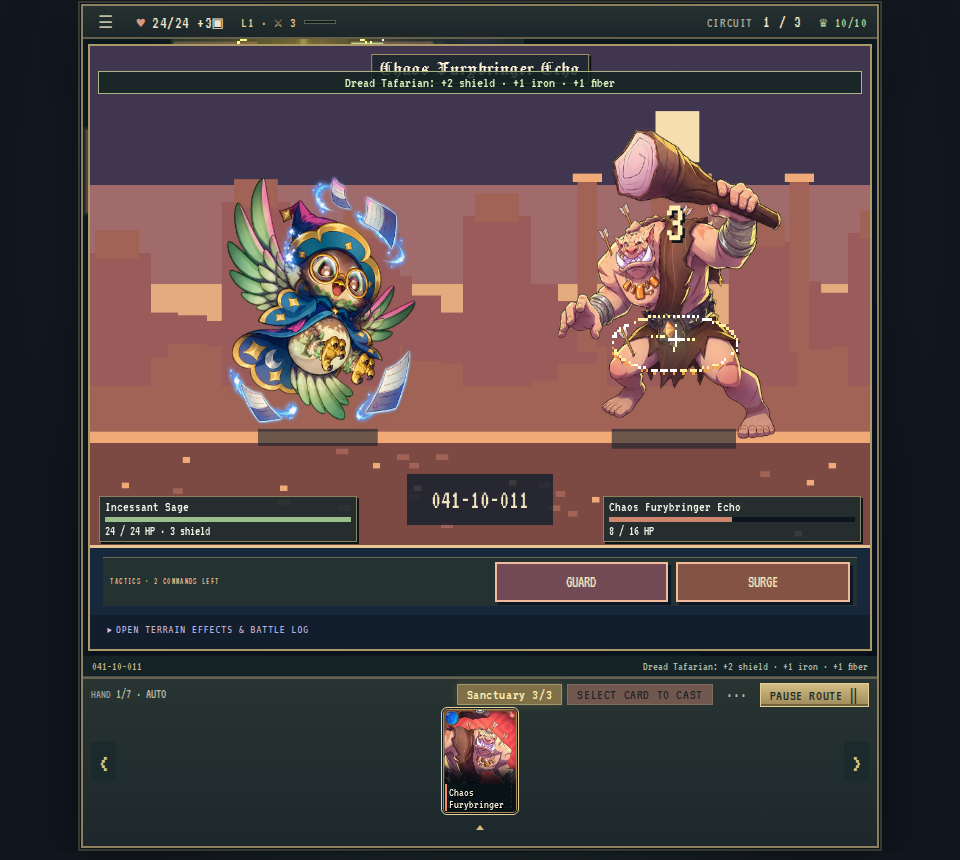
Choose your entrance
- New adventurer: Your first expedition, then the strategy workshop.
- Splinterlands collector: Deck, ownership and levels, all card entries, and the 46-ability translation atlas.
- World architect: Placement, range, stacking and ecology, then Praetoria, terrain and synergies.
- Number hunter: Combat mathematics, growth and progression, the Warden, and hidden rules.
Chapters
- Your first expedition — controls, pauses, hand, objectives and the basic rhythm.
- The collection and drawing library — eligibility, ghost replacements, eight focus cards, opening hand and recycling.
- Archons and Invoke — starting identity, attack intervals, source-card modifiers and elemental powers.
- Worldbuilding — road/verge/wild placement, coverage, duplicate tiers, pressure and evolution.
- Combat mathematics — enemy construction, event order, poison, commands, casts and fatal counters.
- Praetoria and elemental combinations — real coordinates, 14 terrains, reactions, pair recipes and API behavior.
- Growth, equipment and permanent progression — XP, milestones, memories, pacts, relics, keepsakes, camp and Corruption.
- Warden, extraction and rewards — seal mathematics, boss timing, scoring and banked salvage.
- Strategy workshop — opening patterns, build ideas, boss preparation and measured balance limits.
- Hidden rules and current quirks — the details that change good decisions.
- Troubleshooting — what to do when cards, travel, terrain or progress look wrong.
- Rift Trials and run powers — optional elite fights, source-shaped choices, ten powers and the Codex.
- Card Archive — 72 open definitions, nineteen rival hunts, ownership and Mastery.
- Save and resume — exact state, account scope, compatibility, expiry and banking.
Reference shelves
- Complete card encyclopedia: every supported definition, every level, active abilities, changing support role, ghost eligibility and actual model-generated foe samples.
- Ability atlas: all 46 names across world support, combat casts, memories and hostile echoes.
- World-card reference: universal tools, elemental structures and underlying monster roles.
- Terrain and combination tables: numerical terrain effects, reactions, seven hybrid pairs and outpost materials.
- Progression tables: XP thresholds, kill-choice schedule, equipment values, keepsakes and building costs.
- Archon roster: every supported summoner and the common elemental rules.
- Warden phases: all seven aspects, counters and exact phase effects.
- Balance evidence: frozen scenario results, reproduction commands and interpretation limits.
- Run-power catalog: all ten effects, elements and unlock rules.
- Card-by-card design audit: access, strategy, upgrades, local traits and signatures for all 91.
- Regional terrain evidence: verified fixtures and measured policy results.
How to read the evidence
Implemented means inspected in the current client/engine. Observed means reproduced by a named test or playthrough. Strategy inference means advice derived from those mechanics, not a guaranteed winning build. Proposed means not shipped.
Reference tables and card pages are generated from the checked-in catalog and gameplay modules. Card metadata is the game's November 6, 2026 reverified snapshot, not a promise that upstream Splinterlands can never change. The wiki records game behavior; it is not a blockchain ownership authority.
The web edition has search and chapter navigation.